
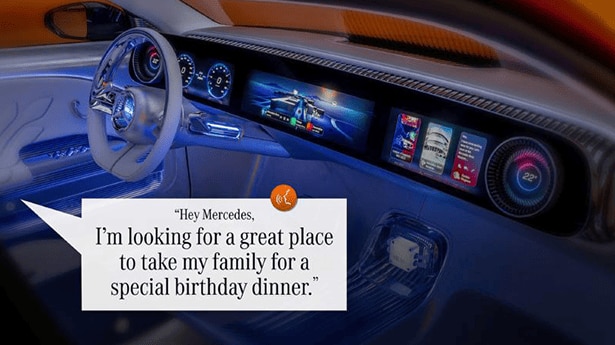
Artificial intelligence inside modern luxury vehicles is no longer limited to basic voice prompts or reactive safety alerts. In the latest engineering portfolio from Mercedes-Benz, machine learning algorithms and cloud-connected large language models operate as a cohesive digital co-pilot. The architecture processes real-time sensor data, driver habits, and environmental context to transform how vehicle occupants interact with automotive technology. By unifying infotainment, safety systems, and vehicle health monitoring, Mercedes-Benz delivers an intuitive, personalized environment that minimizes distraction and maximizes occupant comfort.
Mercedes-Benz artificial intelligence elevates the driving experience by automating complex vehicle adjustments, understanding natural conversational commands through generative artificial intelligence, providing predictive route and climate suggestions, and delivering advanced Level 2 semi-autonomous driving support that safely manages steering, lane-keeping, braking, and parking.
The core foundation of this technological suite rests within the Mercedes-Benz Operating System, known as MB.OS, which powers the latest generation of the Mercedes-Benz User Experience, or MBUX. Rather than forcing drivers to adapt to rigid menu structures or strict vocal phrasing, the system continuously learns individual preferences. Whether adjusting cabin temperature based on time of day, suggesting a preferred navigation route during heavy traffic, or executing multi-step voice requests, artificial intelligence continuously refines its responsiveness.
At James Motor Company Mercedes-Benz, located at our showroom on Richmond Road, our team introduces clients to these intelligent systems during personalized vehicle walkarounds. Prospective owners can explore how these innovations perform during a tailored demonstration by reaching out to our staff at (859) 268-1150.
Why Does Mercedes-Benz Want Generative AI in the Cabin?
Mercedes-Benz integrates generative artificial intelligence into the vehicle cabin to reduce driver distraction, streamline complex interior controls, and create a human-centric interaction model that understands complex, natural conversation.
Traditional automotive voice control systems relied on pre-programmed phrases, requiring drivers to speak precise commands to adjust settings or access information. Generative artificial intelligence eliminates this friction by enabling multi-turn conversations, understanding contextual nuances, and processing indirect requests. When an occupant mentions feeling chilly or requests a route adjustment with multiple stops, the cabin assistant interprets the underlying intent and executes the command instantly without requiring secondary button presses or precise script memorization.
Beyond convenience, introducing artificial intelligence into the cabin directly enhances driving safety. By transferring secondary vehicle controls—such as adjusting media, setting climate zones, checking weather forecasts, or searching for points of interest—to effortless voice interactions, driver focus remains anchored on the road ahead. Board leadership at Mercedes-Benz has consistently emphasized that artificial intelligence is engineered to act as an empathetic, supportive assistant rather than a novel gadget, ensuring every digital feature serves a practical purpose.
This commitment to advanced digital infrastructure extends across both new model debuts and select models found within our pre-owned Mercedes-Benz inventory. For example, high-performance executive sedans like the AMG E53 4MATIC® pair a potent 3L engine generating 577 hp and 553 lb-ft of torque through an AMG SPEEDSHIFT TCT 9G transmission with standard all-wheel drive and sophisticated digital cabin interfaces. Meanwhile, models such as the E350 with its 255 hp and 295 lb-ft 2L engine, the E350 4MATIC®, the 375 hp and 369 lb-ft E450 4MATIC®, and the E450 4MATIC® All-Terrain demonstrate how flexible drivetrain engineering meets cutting-edge onboard computing across the entire lineup.
What Intelligent MBUX Features and ChatGPT Integration Elevate Natural Voice Control?
Integrating ChatGPT through Microsoft Azure OpenAI Service expands the MBUX Voice Assistant into a versatile conversational partner capable of processing complex queries, detailed travel requests, and multi-step commands without rigid phrasing.
Standard automotive voice interfaces often fail when presented with open-ended questions or follow-up statements. With generative artificial intelligence integrated into MBUX, occupants can engage in natural, flowing dialogue. Drivers can ask detailed questions about historical landmarks along their route, request restaurant recommendations based on specific dietary preferences, or ask for explanations of complex subjects while keeping their hands on the wheel. The system retains conversation context over multiple turns, allowing passengers to refine inquiries without repeating initial parameters.
Key features enabled by this advanced software suite include:
- Natural Speech Comprehension: Understands conversational phrasing, regional colloquialisms, and indirect statements without requiring precise voice commands.
- Contextual Follow-Up: Remembers previous questions in a multi-turn conversation, allowing occupants to ask follow-up questions naturally.
- Detailed Knowledge Retrieval: Answers complex queries regarding navigation destinations, local business details, sports scores, or general trivia in real time.
- Integrated Vehicle Control: Translates natural dialogue directly into mechanical vehicle adjustments, such as modifying cabin ambient lighting or activating seat ventilation.
To ensure rapid response times and mitigate connectivity delays in remote driving environments, Mercedes-Benz has partnered with Liquid AI to advance embedded, on-device intelligence. This hybrid approach allows essential vehicle management tasks to process directly on onboard hardware, while cloud networks handle detailed generative inquiries. Shoppers evaluating our Certified Pre-Owned Mercedes-Benz models will find that recent model years showcase this steady evolution toward intuitive, responsive voice computing.
What Kinds of Contextual Suggestions and Personalization Does Mercedes AI Offer?
The MBUX system delivers proactive suggestions and personalized cabin adjustments by analyzing daily driving routines, environmental conditions, frequent destinations, and personal comfort preferences over time.
Rather than remaining passive until called upon, the intelligent assistant observes occupant habits to anticipate needs. For professionals managing a morning commute from Nicholasville, the software recognizes routine departure times and automatically pre-conditions the cabin temperature while queuing the preferred news podcast or navigation route. If traffic conditions along the regular corridor worsen, the system proactively offers an alternate route before the vehicle leaves the driveway.
Personalization extends across multiple driving dimensions throughout the ownership experience:
- Proactive Comfort Routines: Recommends activating heated seats or steering wheel functions when ambient exterior temperatures drop below historical comfort thresholds.
- Intelligent Navigation Prompts: Reminds drivers to initiate routing to weekly commitments, such as athletic practices or scheduled appointments, based on calendar sync and past driving patterns.
- Automated Communication Suggestions: Displays one-touch prompts to place calls to frequent contacts at typical meeting or departure times.
- Dynamic Energy and Route Management: On electric and hybrid models, the system optimizes cabin energy draw based on route topography, traffic flow, and remaining battery range.
Drivers test-driving our luxury sedans frequently ask how natural language commands streamline daily operation before they inquire about horsepower, highlighting how critical digital personalization has become during the buying process.
What Daily Driving and Steering Tasks Can Mercedes-Benz AI Systems Handle Safely?
Mercedes-Benz driver assistance systems utilize artificial intelligence to assist with urban and highway driving tasks—including lane centering, adaptive speed regulation, automated lane changes, stop sign recognition, and precision parking—under active driver supervision.
Through advanced software suites like MB.DRIVE ASSIST PRO, Mercedes-Benz merges driving assistance directly with navigation mapping. Utilizing an array of approximately 30 onboard sensors—comprising 10 optical cameras, 5 radar units, and 12 ultrasonic sensors—a high-performance supercomputer processing up to 508 TOPS (trillion operations per second) builds a real-time 360-degree spatial map around the vehicle. This permits smooth point-to-point guidance across city streets and multi-lane highways.
In daily driving scenarios, the artificial intelligence architecture coordinates several critical driving tasks:
- Active Lane Change Assist: Evaluates surrounding traffic density and speed differentials to execute semi-autonomous highway lane changes when turn signals are activated or to pass slower traffic.
- Traffic Light and Stop Sign Detection: Identifies municipal traffic control markers to assist with controlled deceleration and stopping in complex urban environments.
- Adaptive Cruise Control with Distance Keeping: Maintains safe trailing distances behind leading vehicles, automatically adjusting speed down to a complete stop in heavy congestion.
- Automated Parking Maneuvers: Scans available parallel and perpendicular spaces, controlling steering, gear selection, acceleration, and braking to park the vehicle smoothly.
Independent safety evaluations consistently emphasize that these Level 2 setups require the driver to maintain full attentiveness at all times. By managing mechanical driving stress during tedious commuting conditions, the system reduces driver fatigue while maintaining rigorous safety standards backed by PRE-SAFE® and Active Brake Assist technology.
How Does Predictive AI Telematics Protect Vehicle Value and Diagnostics?
Predictive telematics powered by cloud-based artificial intelligence algorithms monitor real-time vehicle sensor data to identify component wear early, optimize service intervals, and preserve long-term vehicle resale value.
Modern Mercedes-Benz vehicles continuously collect data from mechanical sensors monitoring fluid quality, thermal cycles, brake pad thickness, battery health, and electronic module stability. Artificial intelligence models analyze these telemetry feeds in the cloud, comparing operational data against millions of global driving profiles. When an algorithm detects an anomaly or predicts that a component requires attention, the system alerts the driver and transmits diagnostic details directly to certified technicians.
This proactive approach yields measurable ownership benefits:
- Early Component Wear Detection: Identifies subtle performance deviations before they result in mechanical downtime or cascading system wear.
- Optimized Residual Value: Maintaining documented, predictive component care preserves vehicle mechanical health, directly supporting higher valuation on our online trade-in appraisal form.
- Automated Diagnostic Reporting: Transmits precise fault codes to service advisors prior to appointments, streamlining parts staging and reducing shop turnaround times.
For buyers exploring our new Mercedes-Benz inventory, transparent pricing structures accompany every model tier. The E350 carries a Base MSRP of $63,900, while the E350 4MATIC® is listed at $66,400. The higher-output E450 4MATIC® starts at $72,300, and the versatile E450 4MATIC® All-Terrain is offered at $78,300. The high-performance AMG E53 4MATIC® holds a Base MSRP of $93,350, with a standard $1,350 destination charge applying across all E-Class variants. Investing in a vehicle equipped with predictive diagnostic artificial intelligence ensures these substantial vehicle investments retain their performance capability and market value over years of ownership.
Frequently Asked Questions About Mercedes-Benz AI Technology
Q: Does using ChatGPT in my Mercedes-Benz require a digital subscription?
Basic voice commands and standard vehicle controls function without additional software fees. Advanced generative artificial intelligence features, extended conversational services, and premium cloud connectivity options are typically bundled into digital extra packages offered with a complimentary trial period upon new vehicle purchase, followed by annual or monthly subscription renewals.
Q: How does Mercedes-Benz protect driver privacy and voice recordings when using cloud AI?
Mercedes-Benz enforces strict data protection protocols. Voice data and telemetry transmitted to cloud servers like Microsoft Azure are anonymized, encrypted, and strictly isolated from personal vehicle identification numbers. Voice recordings are processed solely to execute user requests and refine natural language models, preventing unauthorized third-party commercial access.
Q: Can the MBUX voice assistant operate if my vehicle loses cellular network connection?
Essential vehicle control commands—such as adjusting interior temperature, altering fan speed, selecting local radio frequencies, or locking doors—process locally on onboard processors without requiring cellular connectivity. Open-ended conversational queries, live internet searches, real-time traffic routing, and generative trivia answers require an active cellular data connection.
Q: Is the artificial intelligence software in my Mercedes-Benz capable of over-the-air updates?
Yes, the MB.OS platform supports comprehensive over-the-air (OTA) updates. This capability allows Mercedes-Benz to refine voice recognition models, introduce new MBUX software applications, upgrade driver assistance algorithms, and deliver system security enhancements directly to the vehicle without requiring a dealership service visit.
Q: What is the main difference between standard MBUX voice control and generative AI integration?
Standard MBUX voice control relies on structured intent matching, requiring specific phrasing to execute direct vehicle commands. Generative artificial intelligence integration allows the system to comprehend fluid, conversational language, process multi-step inquiries, retain context across long conversations, and provide detailed answers to open-ended questions.
Prices and MSRP referenced in this article are estimates for informational purposes only and do not constitute an offer to sell. See dealer for complete details. Fuel economy estimates shown may differ from official EPA ratings and should not be relied upon as a guarantee of actual vehicle performance.


