
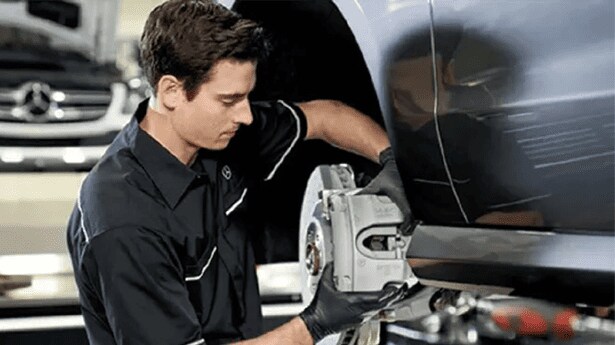
Inspecting Mercedes-Benz brakes before a long road trip requires checking brake pad friction thickness to ensure at least 4 mm of material remains, examining rotor surfaces for lip ridges or heat scoring, testing brake fluid moisture content, inspecting hydraulic lines for leaks, and confirming that no dashboard messages such as Check Brake Wear are active.
A thorough brake evaluation begins with a clear visual inspection of the wheel assembly. Through the open spokes of Mercedes-Benz alloy wheels, our technicians examine the outer brake pad lining against the metal backing plate using a specialized millimeter gauge. Because urban stop-and-go traffic along Richmond Road or high-speed cruising on I-75 puts consistent thermal stress on friction components, verifying pad depth before setting out on highway journeys ensures predictable stopping power under all weather conditions.
Beyond measuring friction pads, a complete inspection evaluates brake rotor condition. Rotors must possess a smooth friction surface free from deep rotational grooves, corrosion pitting, or pronounced outer lip ridges. When brake rotors drop below their factory-stamped minimum thickness threshold, their ability to dissipate heat diminishes, increasing the risk of thermal warping and brake pedal pulsation during prolonged highway braking.
Finally, checking the hydraulic system involves verifying fluid level and moisture saturation in the master cylinder reservoir, examining brake calipers for weeping fluid seals, and scanning the vehicle's electronic diagnostic system. Modern Mercedes-Benz models integrate mechanical braking hardware with sophisticated electronic stability control and advanced driver assistance systems. Ensuring every component operates within factory tolerance guarantees that automatic emergency braking and adaptive cruise control features perform as engineered. For personalized vehicle care, visit our Richmond Road service center or speak directly with our service team at (859) 268-1150.
What Components Should Be Inspected on a Mercedes-Benz Braking System Before Holiday Travel?
A proper Mercedes-Benz brake inspection before holiday travel covers six critical components: brake pad friction linings, brake rotors, electronic wear sensors, hydraulic brake fluid, caliper assemblies, and driver-assist radar integration.
Each component in the braking system plays a distinct role in slowing your vehicle safely, particularly when carrying full passenger loads and luggage over extended distances:
- Brake Pads: Both inner and outer friction pads on every wheel must be evaluated. Inner pads often experience higher thermal buildup and wear faster than visible outer pads due to caliper piston contact points.
- Brake Rotors: Rotors must be measured across their wear surface with a precision micrometer to confirm thickness remains above the manufacturer minimum limit stamped on the rotor hat.
- Electronic Wear Sensors: Contact sensors embedded in the brake pad lining must be inspected for physical wear, wiring harness abrasion, or corrosion at the electrical connector pins.
- Brake Fluid & Lines: Hydraulic fluid must be tested for moisture accumulation using a digital boiling-point analyzer, while flexible rubber brake hoses are checked for cracking or swelling under pressure.
- Brake Calipers & Hardware: Caliper guide pins, dust boots, and hydraulic pistons are checked for smooth lateral movement and leak-free operation to prevent uneven pad dragging.
- Advanced Driver Assistance Integration: Safety innovations such as Active Brake Assist and PRE-SAFE® rely on peak mechanical response from the brake calipers when automated pressure is commanded during an emergency situation.
Daily commuting on routes like US-27 through Nicholasville subjects braking systems to frequent stopping cycles that accelerate wear on heavy luxury sedans and crossover SUVs. Replacing worn components with original equipment manufacturer parts from our genuine Mercedes-Benz parts department maintains exact engineering tolerances, pedal feel, and long-term durability.
How Do You Check Brake Pad Thickness and Minimum Limits Without Removing the Wheel?
You can check brake pad thickness without removing the wheel by using a manual brake pad gauge or precision ruler inserted between the wheel spokes to measure the friction material between the brake rotor and the steel pad backing plate.
New Mercedes-Benz brake pads feature approximately 12 mm of friction material when installed at the factory. As mileage accumulates, the pad material wears down gradually through friction contact with the rotor surface. Knowing how to interpret these measurements helps owners plan maintenance well before traveling:
- 10 mm to 12 mm: Excellent condition; maximum friction depth available for highway travel.
- 6 mm to 9 mm: Good condition; normal wear range with ample service life remaining.
- 4 mm to 5 mm: Caution range; pads are approaching their operational minimum. Replacement is strongly recommended prior to long-distance road trips.
- 3 mm or less: Mandatory replacement threshold; friction material is critically thin, and contact with electronic wear sensors or steel backing plates is imminent.
While measuring outer pad thickness through open alloy spokes on models like the Mercedes-Benz GLE SUV, E-Class sedan, or GLS SUV provides a useful initial estimate, visual checks through wheel spokes cannot reveal inner pad wear. Inner pads interact directly with caliper pistons and can wear up to 1 mm to 2 mm faster than outer pads if caliper slides become dry or restricted. Performing a comprehensive lift inspection ensures all four wheel positions are measured accurately.
How Far Can You Drive When the Mercedes-Benz Check Brake Wear Light Turns On?
When the Check Brake Wear warning message appears on your Mercedes-Benz instrument cluster, you can typically drive approximately 1,000 to 1,500 miles under standard driving conditions before friction material is exhausted and metal-to-metal contact begins.
The Check Brake Wear notification is triggered by a single-use electronic wear sensor embedded in the friction lining of monitored brake pads. When pad material wears down to approximately 2 mm to 3 mm, the sensor pin makes contact with the rotating brake rotor. This contact grinds through a small loop wire inside the sensor, breaking an electrical circuit and sending an immediate warning signal to the vehicle's central display module.
While this system provides a generous advance buffer so drivers can arrange professional service, holiday road travel can shorten this mileage buffer significantly. Carrying heavy cargo, hauling trailers, navigating mountain passes, or encountering severe stop-and-go highway traffic places elevated kinetic energy on thin pad material, generating extreme temperatures that accelerate remaining friction wear.
Ignoring the warning light risks grinding the steel pad backing plate directly against the cast-iron rotor surface. Metal-to-metal contact severely scores the rotor face, destroying components that might otherwise have been resurfaced or reused, while generating intense heat that can damage caliper dust boots and wheel hub bearings. Furthermore, once an electronic wear sensor has been tripped, its internal wire loop is destroyed, requiring a replacement sensor along with new brake pads to extinguish the warning light.
Why Is Overdue Brake Fluid a Travel Safety Concern on Long Trips?
Overdue brake fluid is a serious travel safety concern because brake fluid is hygroscopic and continuously absorbs moisture from ambient air, which dramatically lowers its boiling point and leads to vapor locks during sustained mountain descents or hard emergency stops.
Under normal operation, brake fluid transfers pedal force into hydraulic pressure at the calipers, generating temperatures at the brake pads that can exceed 400 degrees Fahrenheit. Fresh, uncontaminated brake fluid engineered under MB-Approval 331.0 specifications maintains an elevated boiling point above 500 degrees Fahrenheit, easily withstanding high thermal loads. However, moisture entering through microscopic hose pores and reservoir vents lowers this boiling threshold over time:
- Dry Boiling Point (Fresh Fluid): Exceeds 500 degrees Fahrenheit, providing maximum safety margins during repeated hard stops.
- Wet Boiling Point (2–3% Water Content): Drops to approximately 356 degrees Fahrenheit, significantly reducing thermal resistance.
- Vapor Lock Formation: Under severe heat, absorbed water inside overdue fluid turns into steam bubbles. Because steam compresses while liquid does not, the brake pedal drops to the floorboard without transferring force to the calipers.
Mercedes-Benz owner's manuals specify replacing brake fluid every two years at a qualified specialist workshop regardless of mileage driven. Vehicles carrying multi-passenger loads during holiday trips, such as the Mercedes-Benz GLE SUV or GLS SUV, generate substantial kinetic friction when braking down highway inclines. Ensuring fresh brake fluid fills the system protects sensitive internal anti-lock braking valves from internal corrosion while guaranteeing crisp pedal response when stopping power matters most.
How Do Service A and Service B Differ in Scope and Cost for Mercedes Brake Service?
Service A and Service B both include a comprehensive multi-point inspection of brake pads, rotors, lines, and fluid levels, but Service B expands this maintenance scope by adding a complete hydraulic brake fluid flush and replacement.
| Maintenance Feature | Service A | Service B |
|---|---|---|
| Recommended Mileage Interval | 10,000 miles or 1 year | 20,000 miles or 2 years |
| Motor Oil & Filter Replacement | Included | Included |
| Brake Component Inspection | Included | Included |
| Tire Pressure Check & Correction | Included | Included |
| Cabin Dust / Combination Filter | Not Included | Included |
| Hydraulic Brake Fluid Exchange | Not Included | Included |
| Maintenance Counter Reset | Included | Included |
Because Service A focuses primarily on engine lubrication, tire maintenance, and visual component checks, its base cost typically ranges from $250 to $400. In contrast, Service B ranges from $500 to $900 because it incorporates specialized pressure-flushing equipment to exchange hydraulic fluid throughout the entire braking circuit, along with cabin air filtration maintenance.
To maintain your vehicle's factory warranty and long-term mechanical health before setting out on winter journeys, schedule your maintenance through our online service reservation tool and review our current service specials for seasonal maintenance opportunities.
Common Questions About Mercedes-Benz Brake Maintenance Before Holiday Travel
Q: What is the absolute minimum brake pad thickness required before driving on the highway?
The absolute minimum safety limit for Mercedes-Benz brake pad friction material is 3 mm. However, for long-distance holiday road trips involving highway speeds and full passenger capacity, replacing brake pads when they reach 4 mm is strongly recommended. Starting a trip with pads near 3 mm risks depleting remaining friction material during the journey, exposing rotors to costly metal-to-metal scoring.
Q: Do Mercedes-Benz brake wear sensors need to be replaced every time brake pads are changed?
If the Check Brake Wear light has illuminated on your dashboard, the wear sensor has been physically ground down and MUST be replaced alongside the new brake pads. If pads are being replaced preventatively before the sensor makes contact with the rotor, technicians can sometimes transfer the existing sensor. However, installing fresh genuine sensors with every pad replacement guarantees clean electrical contact and reliable future monitoring.
Q: How do you reset the brake pad wear indicator light after installing new brake pads?
The Check Brake Wear warning message resets automatically once a new wear sensor is connected to the vehicle's wiring harness and the ignition is cycled. Unlike oil life monitors or tire pressure monitors, there is no manual menu reset required for basic wear sensors. If the warning message remains active after installation, it indicates a damaged sensor connector wire or an unseated electrical plug.
Q: How does winter road salt and cold weather impact Mercedes-Benz brake performance?
Freezing temperatures, road salt, and de-icing chemicals accelerate surface oxidation on iron brake rotors and can cause caliper guide pins to drag if improper lubrication is present. Cold weather also reduces initial pad grip until friction surface temperatures rise. Thoroughly washing the undercarriage after winter driving and ensuring clean caliper lubrication during routine maintenance prevents binding and uneven pad wear.
Q: What should you do if your Mercedes-Benz experiences a brake warning or failure on the road?
If a red brake warning light appears or pedal pressure drops suddenly, pull over safely to the shoulder immediately. Turn on emergency hazard lights and do not attempt to continue driving. Every owner has access to 24/7 emergency support by pressing the me-button inside the vehicle overhead console or calling Mercedes-Benz Roadside Assistance: 1-800-367-6372 for factory-backed towing and technical assistance.
Ensure Safe Holiday Travel with Professional Mercedes-Benz Service
Preparing your vehicle for upcoming holiday journeys provides invaluable peace of mind for you and your passengers. Whether your vehicle requires a routine multi-point inspection, fresh MB-Approval 331.0 brake fluid, or new genuine brake pads, our factory-trained technicians are equipped with specialized diagnostic tools and authentic components designed specifically for your automobile.
To prepare your luxury vehicle for upcoming highway travel, visit our Lexington dealership facility or call our team directly at (859) 268-1150. You can also learn more about James Motor Company and discover how our commitment to engineering excellence keeps your Mercedes-Benz performing at its peak across every mile ahead.
Prices and MSRP referenced in this article are estimates for informational purposes only and do not constitute an offer to sell. See dealer for complete details. Fuel economy estimates shown may differ from official EPA ratings and should not be relied upon as a guarantee of actual vehicle performance.


